To improve is to Change, to be Perfect is to change often. Winston
Churchill
Change is inevitable, yet, most of the times, change is frustrating;
having to leave a school that you know everyone and everything in to join a new
one, having to change your laptop, your car, in order to buy a new one,
changing work in either a promotion or a quit. With all the progress and light
that these changes promise you, the thought of change itself still always holds
a considerable amount of discomfort.

As everything we do in patterns result with a habit, flexibility,
perhaps the best tool to manage change, is a habit that you can develop by
practice. This habit of remaining open-minded and adaptable to new information
and situations can make you form a pattern of positive reactions by looking for
the opportunity in each “frustrating” and “upsetting” situation, and spotting
what’s best for you in it.
Usually, it’s those people who can remain calm and keep their minds
functioning consciously in the middle of an unexpected crash or problem that
are considered to be superior.
They take a deep breath, relax, and weigh the situation accurately.
They keep themselves calm and unemotional by asking questions and seeking
information when things don’t work out as they expected.
Ineffective people have a tendency to be in a reactive-responsive mode
of behavior much of the time. Instead of consciously and deliberately choosing
their courses of action, they react to what is going on around them, and they
respond to their emotions, sometimes blowing up and sometimes becoming
depressed. They ride an emotional roller coaster. And the very best they can
hope for, in this mode of behavior, is to get back to even, where they were
before they became upset. The Path of Least Resistance, Robert Fritz.
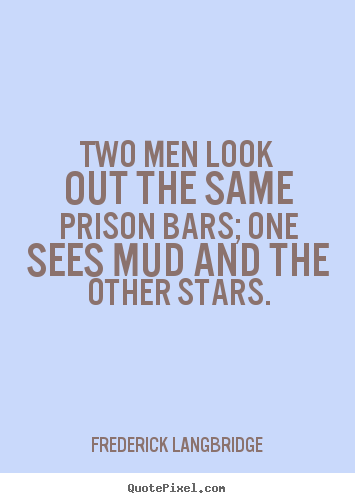 According to Fritz, the superior person concentrates his attention on
his “future vision.” Whenever an unexpected change or setback occurs, the
superior person immediately focuses his mind on where he wants to be at a
future time. This future vision is something that he has planned and given a
lot of thought to, so it is fairly easy to conjure up at a moment’s notice.
According to Fritz, the superior person concentrates his attention on
his “future vision.” Whenever an unexpected change or setback occurs, the
superior person immediately focuses his mind on where he wants to be at a
future time. This future vision is something that he has planned and given a
lot of thought to, so it is fairly easy to conjure up at a moment’s notice.
When everyone around them are drowning into skeptical investigations
about who to blame, and formatting the perfect scenario for the conspiracy that
might be tailored for them, Superior people tend to ask, “what do we do now?”,
“Where do we go from here?”. They
keep themselves performing at their best by thinking and talking about
a desired future
state. Focus your attention on the future, and you can greatly improve
your ability to deal with change.
Think about any stressful situation you had in the near or far past,
what was mostly the reason you felt frustrated? Most of your stress, sadness, and
irritation comes from the fact that you were not in control at that particular
moment or situation, or in any particular area of your life; the critical issue
in dealing with change is the subject of control.
On the other hand, if you recall the times and places you felt the
very best about yourself are those that you were in full control.
Home Sweet home is a perfect example of the above, it is that moment
you reach the place where and when you are in full control, especially after a
long journey of losing it. When you were outside, you felt you were in lack of
control, as if you were moved by external forces, namely traffic, silly
drivers, pedestrians, and of course running behind schedule.
Feeling back in control brings comfort and enjoyment, it is like that
moment when you have finished an exam, or an assignment, or a project, and you
feel like you are back in charge of your life.
Ultimately, in order to deal with change, you have to be always in
full charge over the things you think about, which should come from your
conscious mind since it is the only thing over which you have complete control.
Since change is inevitable and continuous, it is how you think about what
is happening to you that is most important in determining how change affects
you, and whether you use it to your advantage or let it work to your
disadvantage. Brian Tracy
So what type of change do we fear? Is there an exclusive type of
change that brings all the discomfort and fearful feelings in us? Indeed, there
is; we are always afraid of what we will be worse off as a result, not better
off. It is change that implies unpleasant surprises that makes us anxious
fearing, here it is the fear of losing control.
In his book “No Excuses”, the legendary Brian Tracy brings to practice
a very practical way to face fears, he called it the disaster report, he puts
steps into destroying fear almost instantly by first “Defining the worry
situation clearly, being completely clear about a situation brings immediate
ways of its resolution; Second, Identify the worst possible thing that could
possibly happen if the worry situation were to take place. A series of “would
you” questions be asked here about losing a job, a relationship or money; after
asking such questions, one would find that it’s probably not worth all the
worry. The third step is to resolve to accept the worst possible outcome… DEAL
WITH IT if it is meant to happen, how would you manage if the worst possible
came into reality, putting a solid base of resolutions and contingency plans
for it. Finally, Fourth, beginning immediately to improve on the worst, like
the old saying, if it ain’t broke, fix it before its broken.
Tracy’s brilliant way of dealing with fear shows that having a
purposeful and disciplined action in the direction of your goals is the only
cure for fear or worry.
In this part of the world, change is ongoing, it is like our daily
bread an butter, things that are completely out of anyone’s control. In order
to manage change, you have to deal with it, put self-direction, write solid and
specific goals that enable you to plan for change, plan for instability and
control your actions while it happens. We all know that in every situation,
some unexpected disappointments and setbacks will happen, this is the nature of
the market, and life; sometimes you lose in spite of all the efforts, sometimes
unpredictable events puts down all your eagerness and enthusiasm to achieve
something, yet, only the superior people know that all these setbacks,
disappointments and losses are uncontrollable, are like rain in a sunny day,
and reassure their plans constantly with perseverance to fit and use them into
their own benefit.
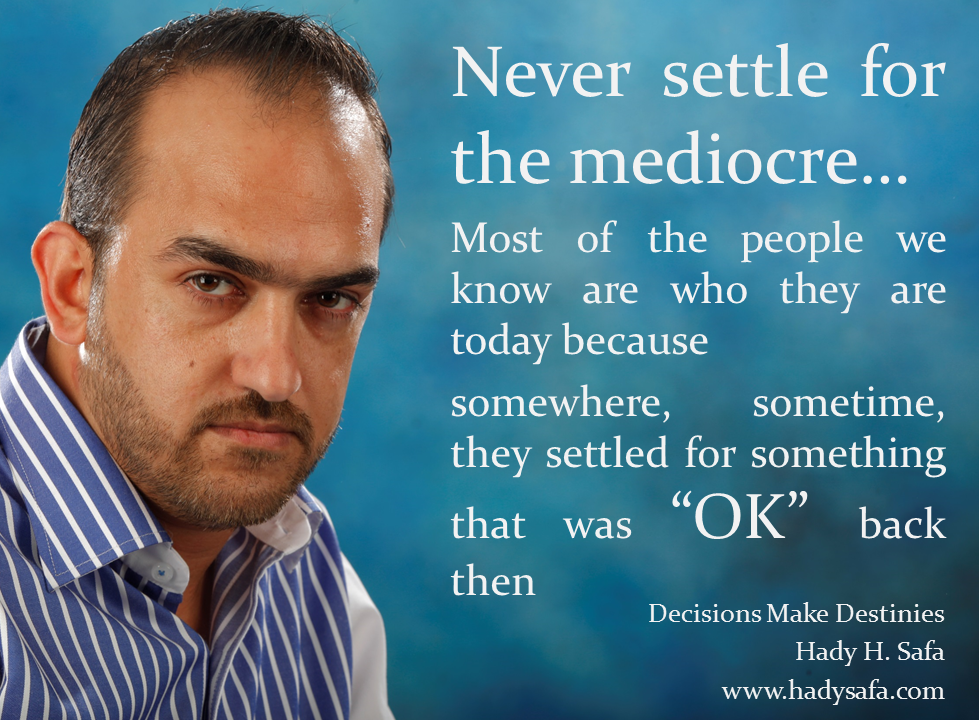
The difference between average and superior is long term planning, so
no matter unexpected events happen, they can make some barriers but never drift
them from their main concentration, their concrete determination of getting
what they want, of reaching the solid goals they have put from the start.
Yes, most goals stay in the level of wishes and dreams, because we
don’t take them and ourselves seriously, I bet 90% of the people you know had
very good new year’s resolutions, but no one made the effort to write them
down, or to ever revisit them again, and eventually they ended up going with
the wave of changes, living in anger and worry, loss of control. Dealing with
change is as constant as change itself, the moment you surrender to it, it
beats you, and we all know we can’t spend our lives crying over spilled milk,
unfortunately we do.
“The last great freedom of man is the freedom to choose his attitude
under any given set of circumstances”. Viktor Frankl


